Creating quieter and safer streets
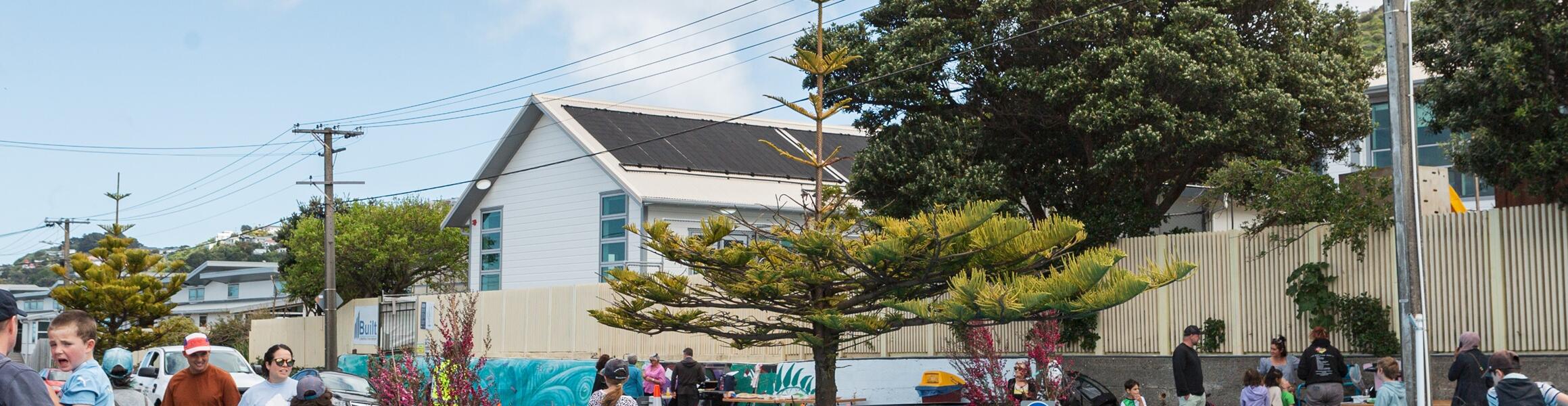
On Freyberg Street, we’ve been trialling changes to create a quieter and safer environment around Lyall Bay School.
These changes made it easier to cross Wha Street and created a child-friendly safe zone outside the school with no through traffic. We also installed a new raised pedestrian crossing on Queens Drive (along with additional speed calming measures) to support safer speeds.
The trial was introduced to address safety concerns raised by the Lyall Bay School community and nearby residents, particularly around traffic speeds, volumes, and the use of local streets as rat runs.
The Freyberg neighbourhood street trial is coming to an end, and Council needs to decide on the next steps.
The changes we made for the trial
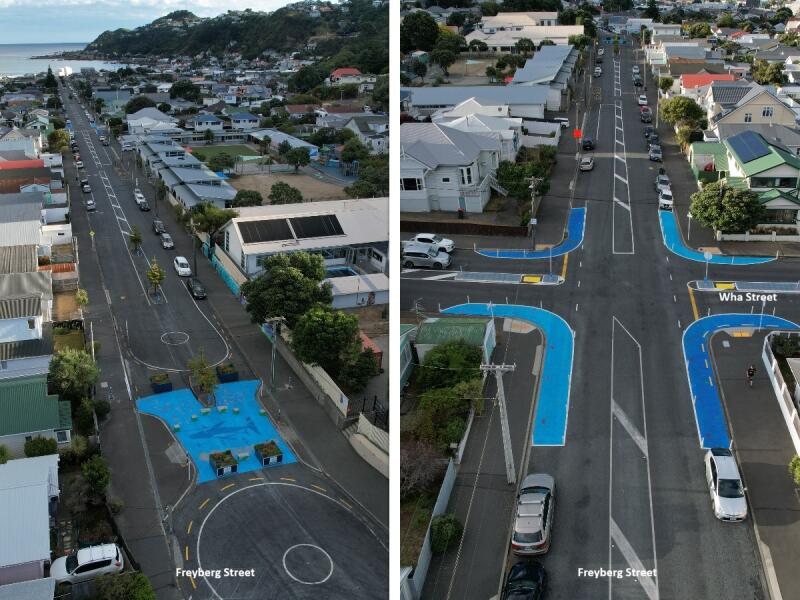
In early November 2023, we introduced a new layout at the intersection of Wha Street and Freyberg Street to encourage slower speeds and make it easier and safer for people of all ages and abilities to cross the road here. Changes have been made at all four corners of the intersection using paint and flexible posts to extend the pedestrian waiting spaces and create two trial central islands on Wha Street.
Further down Freyberg Street by the school entrance, we’ve positioned planter boxes and seats to create and trial a safe pedestrian-friendly area, stretching from one side of the street to the other. Vehicles can still access all properties via Wha Street and Queens Drive, but this section of Freyberg Street is no longer available as a through route. On either side of the new pedestrian area, there are two cul-de-sacs and adjacent turn-around areas.
Students and staff at the school assisted with some of the creative finishing touches, including helping to design and paint a sea-themed mural on the street in the pedestrian area.
Some concerns were raised about increased traffic volumes and speeds on Queens Drive. In response, a raised pedestrian crossing was installed in December 2023 to improve visibility and slow traffic. Further changes in November 2025 improved visibility at the Tavistock/Wha Street intersection and contributed to reducing speeds in the area. The trial was extended to monitor the impact of these changes prior to a decision whether to make it permanent or not.
Data collected during the trial shows:
- speeds are down on Freyberg Street, Queen's Drive and Onepū road
- traffic volumes are significantly down on Freyberg Street and up on Queen's Drive
- heavy vehicle volumes are down on all three street.
Why we need to make a decision
The trial was done under a Temporary Traffic Management Plan (TTMP) which is due to expire.
Data from the trial and community feedback
Following installation of the trial, we monitored vehicle speeds and volumes on Freyberg Street and surrounding streets to see what impact the changes had. We also surveyed the community and school kids to understand what they thought about the changes.
Between 2023 and 2025, we measured vehicle speeds and volumes on Freyberg Street, Queens Drive and Onepū Road to monitor the impact of the trial changes.
Speeds
- Between 2023 and 2025 speeds went down on Freyberg Street by 25%.
- During the same period speeds reduced on Queens Drive by 17%.
- On Onepū Road speeds reduced by 16%.
Traffic volumes
- Traffic volumes have reduced on Freyberg Street by 66%.
- Queens Drive has seen an increase of 21% in vehicle volumes.
- There has been no change in traffic volumes on Onepū road.
Heavy vehicle volumes
- Heavy vehicle volumes have reduced on all three streets - by 35% on Freyberg Street, 38% on Queens Drive, and 8% on Onepū Road.
Once people had had time to adjust to the street changes, we sought community feedback about their experiences. We received 185 submissions through a public online survey between April and May 2024.
- Most respondents lived in the area or had kids at the school (80%)
- For people dropping kids to school, more people felt it was safer with the changes in place (63%), with 30% disagreeing
- Overall, slightly more people felt the changes had made it safer for pedestrians and people who ride bikes in the area (53%), while others disagreed (37%).
People that didn’t like the changes were concerned about traffic speeds and volumes on Queens Drive.
We also interviewed people around the school during drop-off and pick up times.
- The positive themes we heard through these interviews included:
- More walking and biking for school kids
- Increased safety around school pick up
- The mural and blue zone being a place to spend time with the community
- Freyberg Street becoming a quieter street.
“Really supportive. I'm more likely to let my son (9yo) scooter to school alone, and feel much safer scootering or walking with him and his younger brother (4yo). I can see it's improved safety a lot and there appear to be a lot more kids walking, biking, rollerblading or scootering to school”.
“It is fabulous, what’s been done here. It’s clearly a place where kids can come across and it’s been nicely done its attractive…... Absolutely a safer street as it is slowing people down…... I think it does make the place more connected to the school and make it a hub for the community…... Also, I think people can save a bit of money by not driving their kids to school. They can walk”.
“I've really liked it, I think it has created a safe space for the kids and the road does seem quieter. Cars used to just use it as a passageway and it feels more like a school community area now...the kids really like it.... I love this and I really hope it stays”.
The negative themes from the interviews included:
- Inconvenience
- Traffic volumes moving to Queens Drive
- Loss of parking/poor parking habits near the school
“All it's done is force traffic to Queens Drive and I’ve heard near misses of kids not using the crossing getting out of cars and running straight across the road because mum and dad are in a hurry to get to work. This was a drop-off point and a through street where they can do that was way safer.”
“I find it quite inconvenient. When driving through you have to find a different street to drive through and this used to be a main thoroughfare fare to pick up and drop as well as other activities in the area……It was always a fight to get a park here at this time of day and this has made it worse actually because there is even less parking.”
We conducted interviews with students aged 5-11 from Lyall Bay School to understand their experiences moving in the area.
Positive themes included:
- Feeling safer and more independent when commuting to school
- Seeing the ‘blue zones’ as safe areas
- The marine streetscape and seating making the area inviting and playful
- At the Wha/Freyberg streets intersection, shorter crossing distance and pedestrian islands made them feel safer and encouraged slower vehicle speeds
- On Queens Drive, students liked the raised pedestrian crossing slowed cars down, and relocating the road patrol to this crossing increased feelings of safety.
"I like everything but especially the seats because school doesn't open until 8.30 and you can sit there."
"I like the animals and sea creatures, because it makes me feel like it's real."
"Safer, because there's a place to stop in the middle, it gives you a faster way to cross." (Wha Street)
Negative themes included:
- Inconvenience for multi-trip car journeys – particularly if their parents feel this way
- Mopeds still getting through the street closure
- Increased traffic on Queens Drive
"More safe, you need another speed bump, a bigger speed bump, they still go too fast." (Queens Drive)
"Heaps of adults hate it if they're driving." (Freyberg Street)
Trial details and our proposed option
What we’re proposing:
Our proposed option is to make the temporary changes permanent including:
- the ‘no stopping at all times’ restrictions that are already in place in the turnaround areas on either side of the closed crossing area
- the ‘no stopping at all times’ restrictions that are already in place around the corners of the Wha Street/Freyberg Street intersection associated with installing pedestrian islands.
This means we would:
- make the crossing area on Freyberg Street outside numbers 19 and 21 permanent
- retain the planter boxes and furniture in the crossing area
- install permanent ‘No Stopping At All Times’ at the turn around areas north and south of the closed in pedestrian crossing area
- install ‘No Stopping At All Times around the four corners of the Wha Street and Freyberg Street intersection and permanent protective pedestrian islands at each corner.
These changes improve safety and accessibility for pedestrians and cyclists particularly the children from all over Kilbirnie and Lyall Bay who travel to and from Lyall Bay school.
Making the changes permanent provides a safe crossing space to Lyall Bay school for parents and children as well as for residents. This also means a shorter and safer crossing for pedestrians at the Wha Street/Freyberg Street intersection.
What this means for people in cars
While cars would still be able to access all properties via Wha Street and Queens Drive, this section of Freyberg Street would remain unavailable as a through route. Onepū Road and Queen's Drive would still act as feeder routes to allow for through traffic to continue down the remainder of Freyberg Street.
The net parking impact of these changes is:
- permanent removal of 7 unrestricted parking spaces at the closed crossing area.
- permanent removal of 4 unrestricted parking spaces on Freyberg Street at the Wha Street intersection.
Note that all of these were already removed in 2023 under the temporary traffic management plan, so this traffic resolution is not proposing any change from the current state, just formalising it.
The plans and traffic resolution
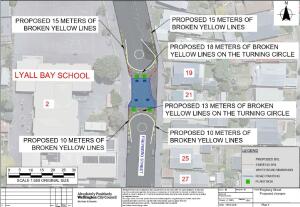
You can find more information about what is proposed for Freyberg Street by reading the plans and traffic resolution report
Option 1: Remove the temporary road closure and intersection changes and return the road as it was prior to installation
This option is not preferred as it would increase volumes and speeds on this road to pre installation levels and reduce road safety for the school children and their families as well as for local residents.
Option 2: Remove the road closure and leave the intersection changes in place
This option is not preferred as, although it retains improved crossing distances at the intersection, it does not lower speeds or volumes of traffic along Freyberg Street and in front of the school. The key speed and volume reductions seen from this trial and improved safety in front of the school are a direct result of the road closure to through traffic.
Option 3: Leave the Temporary Traffic Management Plan in place
This is not a preferred solution as these are only intended for trialling road layouts and are not considered a permanent solution. This also does not provide certainty for the community.
The Lyall Bay School board, a parent working group, local residents, and wider community were actively involved in shaping the trial.